With the aim of becoming a company capable of contributing to society through the creation of business, the Prestige International Group creates services that resolve social issues by endeavoring to solve social problems and contribute to local communities through business activities.
Accordingly, with the damage caused by global climate change and natural disasters worsening in recent years, the Group regards climate change as a top priority; therefore, the company decided to accurately assess the impact of climate change on the Prestige International Group and proactively promote a variety of different environmental measures, including the reduction of CO2 emissions.
In line with the TCFD framework, moving forward the Group will endeavor to analyze the risks and opportunities that climate change may bring to Prestige International, reflect these in the management strategies, and disclose information based on recommendations.

Governance
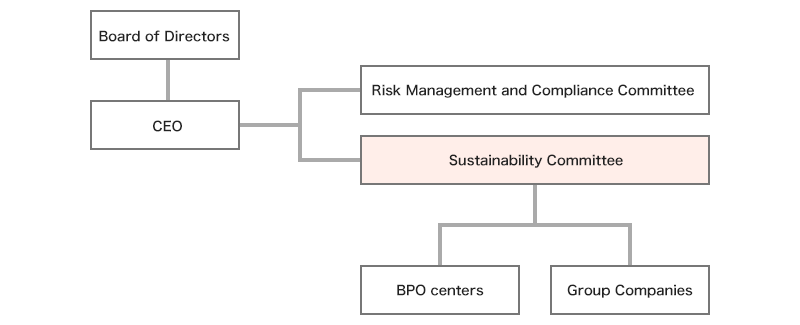
The Prestige International Group established a Sustainability Committee to consider issues related to the environment and society’s needs. The committee generally meets every quarter with ad hoc meetings held as necessary. The Sustainability Committee also examines the relationship between management activities and business risks as considered by the Risk Management and Compliance Committee by evaluating the possibility and frequency of such risks occurring and their potential impact in the event that they do occur, ascertaining their significance, and submitting reports to the Executive Board or the Board of Directors as necessary. Under the supervisory system overseen by the Board of Directors, these issues and risks are reflected and addressed the Group's strategies.
Corporate Governance System
Scenario Analysis
Analysis Method
Scope of Analysis
Prestige International Group Overall
Definition of Importance
In assessing the financial impact of climate change, the impact classification is based on the criteria for timely disclosure by the Financial Instruments Exchange in relation to revisions to earnings forecasts, differences between forecasts and financial results, and the damage caused by disasters or the damage incurred in the course of business operations; an anticipated 10% increase/decrease in consolidated net sales or 3% increase/decrease in consolidated net assets is regarded as "a significant impact" .
The quantitative information in the scenario analysis is based on the company’s judgment using reference scenarios. Although care has been taken to improve the accuracy of the analysis, it contains many uncertain factors.
Impact
classification |
Criteria |
Amount |
| Large |
Ratio to consolidated net sales: |
10% or higher |
6.4 billion yen or higher |
| Ratio to consolidated net assets: |
3% or higher |
1.5 billion yen or higher |
| Medium |
Ratio to consolidated net sales: |
5% or higher/less than 10% |
3.2 billion yen or higher/less than 6.4 billion yen |
| Ratio to consolidated net assets: |
1.5% or higher/less than 3% |
700 million yen or higher/less than 1.5 billion yen |
| Small |
Ratio to consolidated net sales: |
less than 5% |
less than 3.2 billion yen |
| Ratio to consolidated net assets: |
less than 1.5% |
less than 700 million yen |
* Calculated on the basis of actual performance for the period ended March 2025.
Setting of Scenarios
When considering the scenario analysis, the company referred to materials published by the International Energy Agency (IEA) and the Intergovernmental Panel on Climate Change (IPCC)—organizations that have high international credibility, are referenced in TCFD recommendations and are able to cover a wide range of business areas—and set the following two scenarios.
Analysis Results
- *1 Timelines for full realization of risks and opportunities Short-term: 2025; Medium-term: 2030; Long-term: 2050
- *2 At this stage is difficult to collect sufficient information at this stage and assess the extent of the impact on business and finances.
- *3 In the less than 2°C scenario, it is anticipated that the frequency of natural disasters, such as typhoons, torrential rains, and floods, will increase, but there will be no natural disasters that directly affect business continuity at BPO centers.
- *4 In the 4°C scenario, the maximum impact would be one of the BPO centers flooding and operations being suspended.
Strategies
- The Prestige International Group operates contact centers (BPO centers) mainly in the Tohoku region. The main sources of CO2 emissions in Scope 1 and Scope 2 are electricity and gas consumption at BPO centers and fuel consumption by service vehicles for roadside assistance services.
- In order to reduce CO2 emissions, the company will progressively introduce renewable energy and replace roadside assistance service vehicles with electronic vehicles (EVs). Reducing CO2 emissions not only reduces the company’s environmental impact but also mitigates the financial impact of carbon taxation.
- With regard to transition risks, the risk of increased costs from policies, laws, and regulations was identified in both the under 2°C and 4°C scenarios. However, the financial impact on the Prestige International Group envisioned for 2030 is shown in the table below, and the Group ascertained that the financial impact would be minor if the above measures were implemented.
- With regard to physical risks, the Group has ascertained that the financial impact on the company of the 4°C scenario would be significant, mainly because of the risk of flooding affecting BPO center operations as a result of the anticipated increase in the severity and frequency of natural disasters in addition to rising sea levels. The Group will continue to implement measures to minimize the impact on business continuity by further strengthening the backup system among BPO centers and adopting stricter location conditions for establishing new BPO centers. At the same time, in order to ensure employee safety, the Group will continue conducting disaster drills and reviewing stockpile contents and quantities.
- Customer needs related to electric vehicles (EVs) present both risks and opportunities for the Prestige International Group. The Group has a training facility, Toyama Training Field, which allows the company to efficiently and intensively conduct training mainly on roadside assistance services, and the Group recognizes that strengthening its response to EVs could bring opportunities.
- We have launched the “On-Site EV Emergency Recharging Service,” using our existing service network to respond to cases where EVs run out of power while driving, enabling vehicles to be recharged directly on-site without towing to a charging station, and as of May 2023, the service has been deployed nationwide across all 47 prefectures in Japan.
Financial Impact on the Prestige International Group Envisioned for 2030
Based on FY 2021.3 emissions, the Group estimates that carbon tax for the Prestige International Group will be approximately 154 million yen. However, by systematically introducing renewable energy and electric vehicles (EVs) in order to achieve our company’s CO2 emissions reduction targets, the Group estimates that the carbon tax can be reduced to approximately 77 million yen.
| Item |
Financial Impact |
| Carbon tax *1 |
76 million yen |
| Cost of introducing renewable energy |
10-16 million yen |
| Cost of carbon offsetting *2 |
4-105 million yen |
- *1 Calculated based on the carbon price in developed countries in 2030. (USD130 (IEA NZE2050)); Exchange rate JPY/USD 149.52 (March 31, 2025)
- *2 Calculated based on the average sales price of J-credits and the price of Green Power Certificates in May 2023.
Risk Management
Process for Identifying and Assessing Climate-related Risks
Within the Prestige International Group, the Sustainability Committee identifies issues and risks related to the environment and society’s needs and considers these along with the risks related to management and business activities that are considered by the Risk Management and Compliance Committee. The Sustainability Committee reviews the issues and risks considered by both committees and establishes their relationships by selecting risks and opportunities accompanying climate change that are important to the Group. The Committee then evaluates the significance of the selected climate change-related risks and opportunities based on the likelihood of their occurrence and their financial impact on business.
Process for Managing Climate-related Risks and Integration into the Risk Management System Overall
Conventionally, the Risk Management and Compliance Committee has been responsible for determining and developing the risk management policies of the Prestige International Group, formulating risk management regulations and verifying their operational status, responding to crises, and other matters related to risk management overall. With regard to climate change-related risks, in addition to the above, the Sustainability Committee—a body established for the purpose of discussing initiatives for solving environmental and social issues—identifies and considers climate-related risks related to business activities and identifies high-impact significant risks. Related transition risks and physical risks are identified and assessed, including scenario analysis, in accordance with the framework of TCFD recommendations. With regard to the identified risks, under the supervision of the Risk Management and Compliance Committee and the Sustainability Committee, the relevant departments formulate, implement, and report on measures to address climate change, and both committees work together to check the progress of these measures. In addition, the Sustainability Committee consolidates, discusses, and then summarizes the status of the Group's overall response, reporting important matters to the Executive Committee and the Board of Directors under the supervision of the CEO and reflecting and addressing these in the Group's strategies as corporate risks to the Group under the supervision of the Board of Directors.
Targets
Based on the results of the scenario analyses, the Prestige International Group has set CO2 emission reduction targets in order to reduce the risks accompanying climate change.
Past CO2 Emissions Performance and Targets for 2030 and 2050
【unit;t-CO2】
| Item |
FY2022.3
performance |
FY2023.3
performance |
FY2024.3
performance |
FY2025.3
performance |
2030
targets |
2050
targets |
| Scope 1 |
Emissions from gasoline and diesel oil |
3,423 |
3,802 |
4,133 |
4,616 |
1,550 |
0 |
| Emissions from LPG, LNG, and city gas |
1,633 |
1,566 |
887 |
846 |
683 |
0 |
| Total for Scope 1 emissions |
5,055 |
5,367 |
5,019 |
5,462 |
2,234 |
0 |
| Scope 2 |
Total for Scope 2 emissions |
3,692 |
4,037 |
1,673 |
1,608 |
1,688 |
0 |
| Total for Scope 1 and 2 emissions |
8,748 |
9,405 |
6,692 |
7,070 |
3,921 |
0 |
* If the electricity consumption of some overseas subsidiaries is unknown, a rough estimate is calculated based on electricity rates, the country’s electricity rate market, and office floor area.
Initiatives to Reduce CO2 Emissions
The Prestige International Group will implement the following initiates aimed at achieving the CO2 emissions reduction targets in order to reduce the risks accompanying climate change.
Scope 1(Direct emissions from fuel combustion)
City gas used at each BPO center will be gradually replaced with CN gas (carbon neutral gas) by 2030.
→Anticipated annual decrease in CO2 emissions by 2030: approx. 1,300t-CO2
* First Phase begin to at Toyama BPO Town in January 2023.
→Annual decrease in CO2 emissions: approx. 470t-CO2
Anticipated decreases in CO2 emissions reductions if each measure is implemented by 2030
【Unit;t-CO2】
Of the Prestige International Group’s approx. 450 company cars, approx. 240 cars will be gradually replaced with EVs by 2030.
→Anticipated annual decrease in CO2 emissions by 2030: 1,000t-CO2
Response to the Spread of Evs
Premier Assist Inc., a group company, is engaged in the installation of EV charging stations. Within our group, charging stations have also been installed at directly operated sales offices and domestic BPO centers, contributing to the development of EV charging infrastructure in Japan.
As part of these efforts, we have launched the “On-Site EV Emergency Recharging Service”, which uses our existing service network to respond to incidents where EVs run out of power while driving. The service enables vehicles to be recharged directly on-site, without the need for towing to a charging station. As of May 2023, this service has been rolled out nationwide across all 47 prefectures in Japan.
We will continue to work on developing services and systems to address new demands surrounding the mobility society, as well as to solve issues arising from changes in society and the environment.
Scope 2(Usage of electricity supplied by other companies)
Environmental measures model facility “Iwate BPO Fortress”
We will position the 'Iwate BPO Fortress,' which opened in June 2024, as a model facility utilizing 100% renewable energy, and use it as a reference for subsequent facility construction and facility renovation.
We have partnered with an electric power company to use parking lot space the size of 114 parking spaces for solar power generation using a Power Purchase Agreement (PPA), supplying electricity to the Iwate BPO Fortress.
In June 2025, we supplied an average of 47.8% of our electricity.
Measures to be implemented at existing and newly established BPO centers
- We are promoting the introduction of the latest energy-efficient equipment (lighting, air conditioning, communication devices, etc.).
- The status of renewable energy adoption is shown in the table below.
The status of renewable energy introduction is as shown in the table below.
For CO2 emissions that cannot be reduced, the carbon offset system is utilized.